AI-based blended learning is helping schools get more out of the tools they already have, like smart boards, digital content and capable teachers.
Across classrooms today, something interesting is happening. Even in schools that are well-equipped, educators are asking an important question: How do we make learning truly work for every student?
The answer isn’t about adding more screens or platforms. It’s about using technology in a way that understands each learner, supports teachers, and fits naturally into the classroom flow.
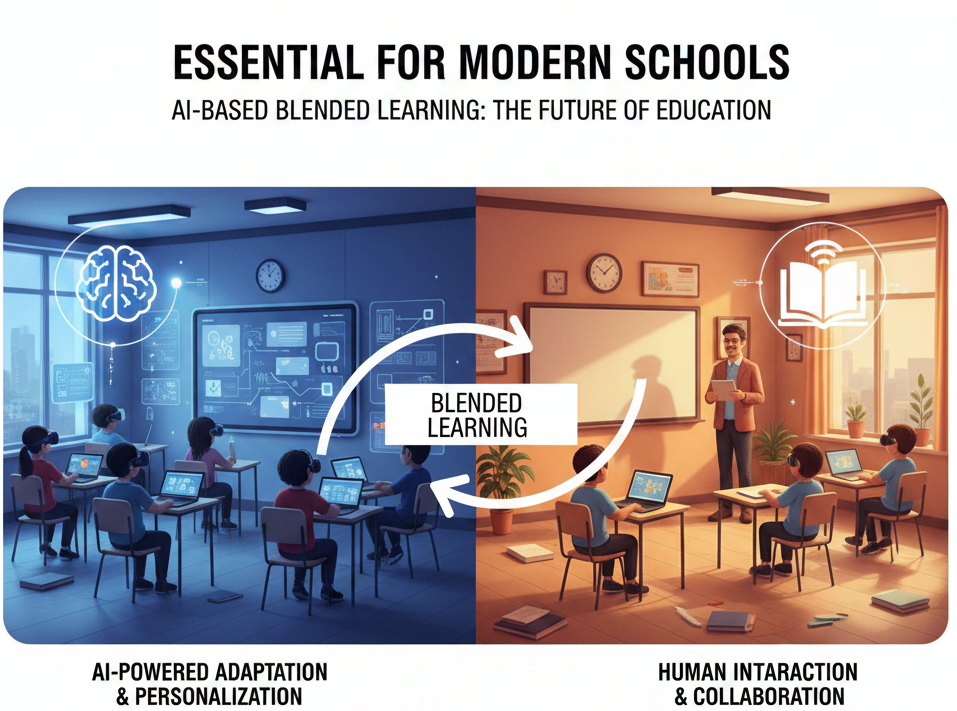
As classrooms become more diverse and student attention spans evolve, AI-based blended learning offers a balanced, practical way forward, combining human teaching with intelligent support to create learning experiences that are personal, engaging, and measurable.
The Problem Modern Classrooms Are Quietly Struggling With
Every teacher knows that learning does not happen at the same speed for every child. In one classroom, there may be students who grasp concepts instantly, others who need repetition, and some who hesitate to even ask questions. Traditional classroom teaching, however dedicated the teacher may be, cannot realistically personalise learning for each student every day.
This gap becomes even more visible in subjects like English, where language exposure, confidence, and home environment play a huge role. Many students understand concepts but hesitate to speak. Others memorise answers but struggle to apply knowledge independently.
This is where blended learning in schools begins to make sense. By combining classroom instruction with digital learning, students get additional time and space to practise, revise, and strengthen concepts without fear or pressure. Learning does not stop when the bell rings. It continues at a pace that suits each learner.
The benefits of blended learning become visible not in theory, but in everyday classroom behaviour, students participate more, teachers spend less time repeating the same explanations, and learning becomes more balanced.
What Changes When AI Enters Blended Learning
Blended learning on its own adds flexibility. AI-based blended learning adds intelligence.
Artificial intelligence observes how students learn. It notices patterns that are impossible to track manually in large classrooms. For example, it can identify when a student repeatedly struggles with sentence formation, pronunciation, or comprehension. Instead of waiting for an exam to reveal this gap, the system responds immediately by offering more practice, simpler explanations, or different formats.
This is what makes AI different from traditional digital tools. It does not treat every student the same. It adapts continuously.
In large education studies, adaptive learning platforms have shown significantly higher engagement and faster concept mastery compared to static digital content. In Indian school pilots, AI-supported learning has delivered learning gains equivalent to almost two academic years within a much shorter period when used consistently.
For teachers, this means fewer students silently falling behind. For students, it means learning feels achievable instead of overwhelming.
Why School Leadership Is Paying Attention
From a principal’s point of view, the biggest challenge is not introducing new tools, but ensuring consistency and quality across classrooms. AI education for schools offers something leadership teams have always needed but rarely had, clear visibility into learning.
AI-powered blended learning systems provide real-time insights into how students are progressing across grades and sections. This is not about monitoring teachers, but about understanding learning patterns. Schools can identify gaps early, support teachers better, and make informed academic decisions instead of reacting after results are declared.
These advantages of blended learning are particularly important for growing schools where maintaining the same learning standards across classrooms becomes increasingly difficult.
Alignment With NEP 2020 and National Priorities
The National Education Policy (NEP 2020) clearly moves Indian education away from rote learning toward understanding, skills, and flexibility. It recognises that technology must support this shift, not distract from it.
Technology-enabled education, when done correctly, allows learning to become more personalised and continuous. AI-based blended learning fits naturally into this vision. It supports competency-based learning, encourages independent thinking, and allows students to learn beyond fixed classroom hours.
This is why many educators now see blended learning not as an experiment, but as a foundation of modern school learning models aligned with national goals.
Teachers Remain Central, Not Replaced
One common fear around AI is that it will reduce the role of teachers. In reality, the opposite happens when AI is used thoughtfully.
AI handles repetitive practice, basic feedback, and progress tracking. Teachers focus on explaining concepts, motivating students, managing discussions, and building confidence. Instead of guessing who needs help, teachers know exactly where to intervene.
This changes the quality of teaching. Teachers are less exhausted by repetition and more engaged in meaningful instruction. These are real, lived blended learning benefits that improve both teaching satisfaction and student outcomes.
Smart Classrooms Are About Learning, Not Screens
In India, smart classrooms are often associated with hardware, screens, tablets, or projectors. But smart learning is not about equipment. It is about responsiveness.
When smart classrooms are combined with adaptive learning platforms, students get a safe environment to practise, make mistakes, and improve privately. This is especially powerful for language learning, where fear of embarrassment often blocks participation. Students gain confidence gradually, not through pressure, but through practice.
What Most Schools Miss About Blended Learning
Blended learning fails when it is treated as extra work or an add-on. It succeeds when it becomes part of daily learning.
Schools that see real impact integrate blended learning into timetables, train teachers continuously, and use learning data to support students rather than label them. The focus remains human, technology simply supports better decisions.
Preparing Students for a Future That Will Use AI
The future students are entering will not separate learning from technology. AI will be part of work, communication, and decision-making.
Schools that introduce AI-based blended learning early are not just improving marks, they are building adaptability, confidence, and independent learning habits. That is the deeper value of this approach.
AI-based blended learning is essential for modern schools because it reflects how students actually learn today.
It respects teachers’ expertise, supports diverse learners, aligns with NEP 2020, and prepares students for a rapidly changing world. It is not about replacing classrooms. It is about strengthening them.