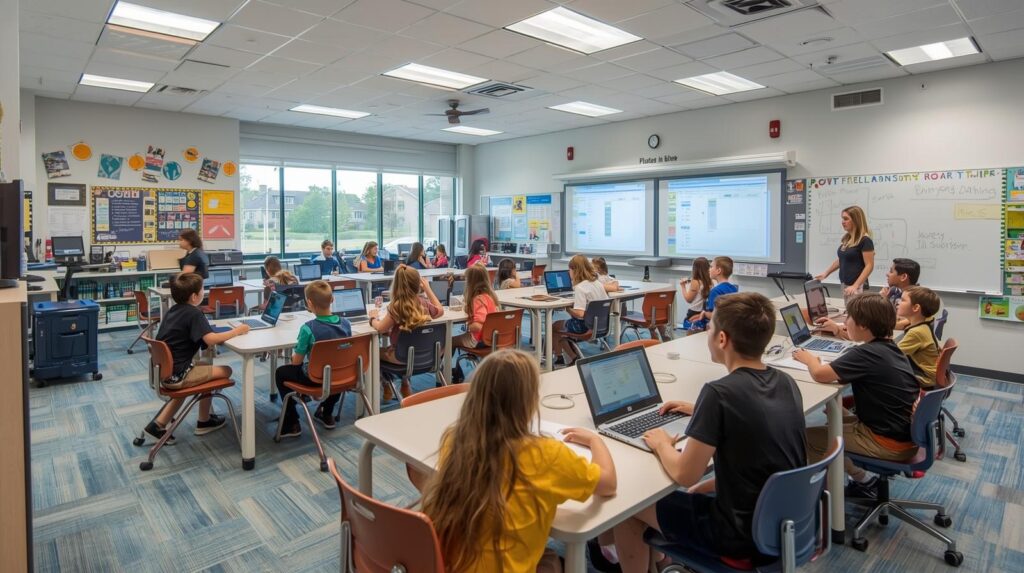
Schools everywhere are facing the same challenge: how do we prepare students for the future without constantly adding new infrastructure, expensive labs, or increased operational costs? This question becomes even more complex in blended and STEM classrooms, where students must not only understand concepts but also communicate, collaborate, and think critically in English.
Many educators are asked how to modernise classrooms while budgets remain fixed. Students, meanwhile, keep asking simpler questions like how to learn English easily or how can I speak better in class? The solution lies not in more buildings or hardware, but in smarter learning design.
Future-ready blended and STEM classrooms can be built without additional infrastructure or cost by integrating AI-supported learning tools that strengthen English learning and speaking skills alongside academic instruction.
Why Infrastructure Is No Longer the Main Barrier
In the past, upgrading education meant adding computer labs, smart boards, or new classrooms. Today, most schools already have basic digital access. What they lack is an efficient way to personalise learning within existing systems.
Blended learning does not require new buildings. It requires better use of time, tools, and teaching strategies. STEM classrooms especially benefit from approaches that support language comprehension without slowing academic progress.
The biggest obstacle is not space or hardware. It is the gap between what students understand and what they can express.
The Role of English in Blended and STEM Classrooms
English is the language of instruction for most STEM subjects. Students must read problems, follow instructions, explain reasoning, and collaborate with peers. Weak English skills can make capable students appear disengaged or underperforming.
This is why many learners search for a learn English grammar app or an app to learn English speaking even when their main goal is to improve academically. They are not trying to become language experts. They are trying to participate fully in class.
Blended classrooms that address English learning and speaking alongside subject content remove this barrier without changing the curriculum.
How Technology Enables Learning Without Extra Cost
Most schools already use some form of digital learning. The difference lies in how effectively it is used. AI-powered tools can operate on existing devices and schedules, requiring no new infrastructure.
These tools provide guided practice, immediate feedback, and personalised learning paths. Students can practice outside class hours or during structured learning periods without increasing teacher workload.
This approach answers a common concern: how to learn English easily while managing other subjects. The key is consistency, not complexity.
Building Speaking Confidence Without More Class Time
One of the biggest constraints teachers face is time. There is rarely enough class time for every student to speak regularly.
An app to learn English speaking solves this by shifting practice outside limited classroom minutes. Students practice explanations, responses, and conversations independently. By the time they speak in class, they are more confident and prepared.
This reduces hesitation and improves participation without adding extra periods or staff.
Grammar Learning That Supports Understanding
Grammar is essential, but traditional grammar teaching often feels disconnected from real usage. A well-designed learn English grammar app helps students understand grammar step by step, in context.
Instead of long lessons, students receive short, targeted corrections as they practice reading or speaking. Over time, grammar improves naturally because it is linked to actual communication.
This method supports STEM learning, where clarity matters more than memorising rules.
Supporting Mixed-Ability Classrooms Naturally
Blended classrooms include students with different learning speeds and language exposure. Some grasp concepts quickly but struggle to explain them. Others understand slowly but speak confidently.
AI-supported learning adapts to these differences without labelling students. Each learner practices at an appropriate pace. Advanced students move ahead, while others receive reinforcement quietly.
This creates inclusion without extra resources or segregation.
Teachers Remain Central to Learning
Future-ready classrooms do not remove teachers from the equation. They empower them.
With AI-supported insights, teachers can see patterns in student progress. They know who needs encouragement, who is improving steadily, and where misunderstandings occur. This allows focused intervention rather than broad repetition.
Teachers spend less time correcting basics and more time guiding thinking, discussion, and application.
English Learning as a Daily Habit
The best way to learn English speaking is through regular exposure and use. Not through occasional exams or intensive courses.
When English learning and speaking become part of daily routine, confidence grows naturally. Short, consistent practice supported by technology builds stronger results than infrequent, high-pressure assessments.
This habit-based approach fits seamlessly into blended learning without requiring new infrastructure.
Preparing Students for the Future
Future-ready classrooms focus on skills students will use beyond school. Communication, collaboration, and clarity of thought matter as much as technical knowledge.
STEM careers demand explanation, presentation, and teamwork. Students who can articulate ideas confidently have a clear advantage.
By integrating English learning into everyday instruction, schools prepare students for real-world expectations without redesigning buildings or budgets.
Cost-Effective, Scalable, and Sustainable
The most powerful advantage of this approach is scalability. Once integrated, AI-supported learning tools can reach every student consistently.
There is no need for repeated investment in infrastructure. Growth happens through better learning design, not bigger classrooms.
This makes blended and STEM education more sustainable in the long term.
Common Misconceptions
Some worry that technology increases screen time or distracts learners. In practice, guided tools enhance focus when used with purpose.
Others fear grammar or fundamentals will be neglected. In reality, structured digital practice reinforces basics more consistently than traditional methods alone.
The key is balance and intent, not avoidance.
Conclusion
Building future-ready blended and STEM classrooms does not require new infrastructure or rising costs. It requires smarter integration of tools that support how students actually learn.
By strengthening English learning and speaking through accessible digital support, schools remove one of the biggest barriers to academic success. Students learn how to learn English easily, practice confidently, and apply language naturally across subjects.
The future of education is not built with more walls or devices. It is built with better learning experiences, designed to work within what schools already have.
Book a free Zene AI demo and see how English communication can thrive across classrooms without increasing teacher workload.
Visit: www.zene.ai