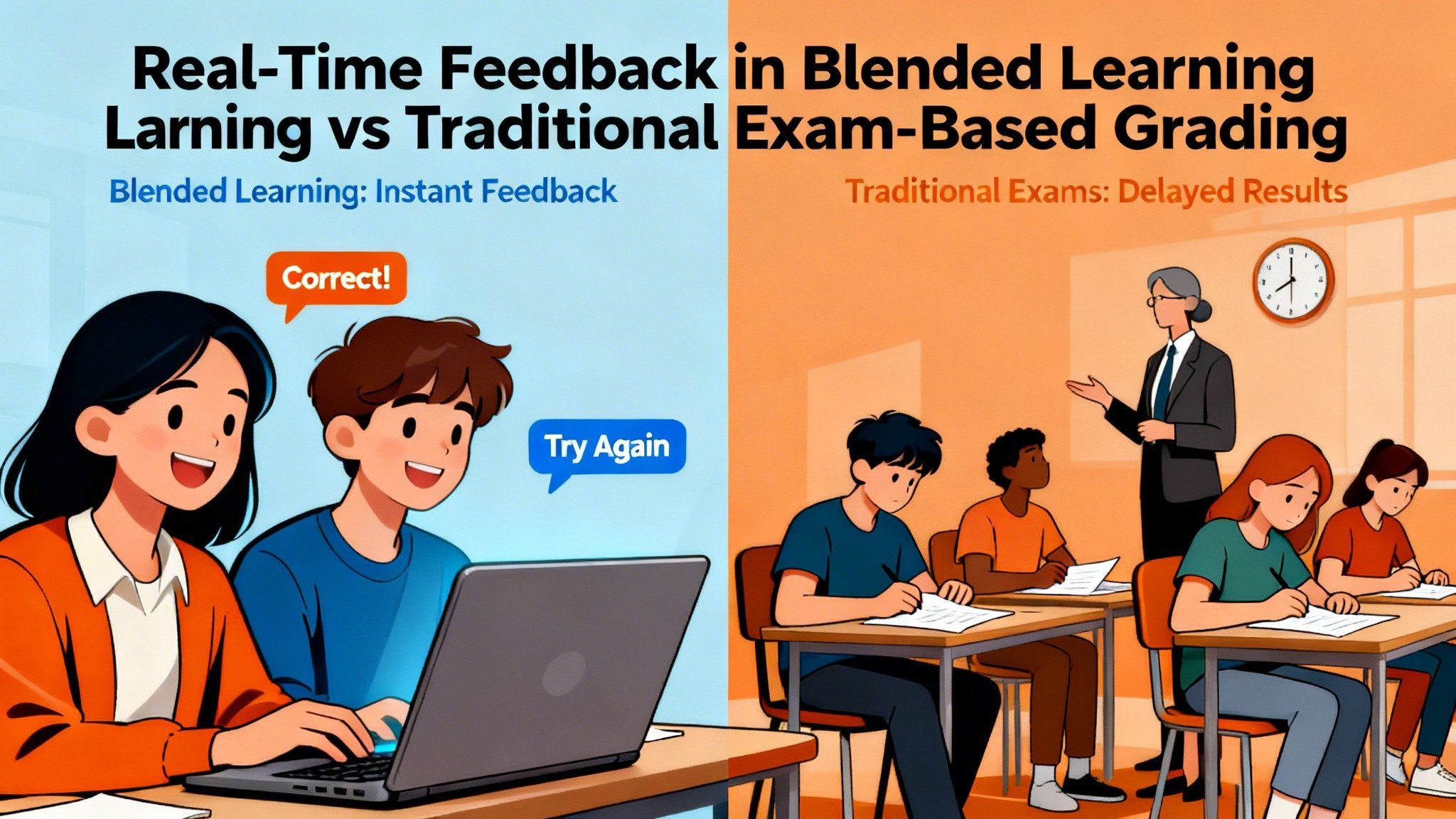
Students, parents, and even teachers are asking the same question today: Is traditional exam-based grading really the best way to measure English learning anymore? Marks and report cards still dominate schools, yet many learners who score well struggle to speak confidently. At the same time, students who communicate clearly are often labelled “average” because exams fail to capture real ability.
Real-time feedback in blended learning is far more effective than traditional exam-based grading for learning English because it supports continuous improvement, builds speaking confidence, and answers what learners actually need to know- how can I improve my speaking skills in real situations?
Why Traditional Exam-Based Grading Falls Short
Traditional exams measure performance at a single point in time. They reward memory, writing speed, and accuracy under pressure. While these skills matter, they do not reflect how English is actually used in daily life.
In most schools, students learn English primarily to pass tests. Grammar rules are memorised, essays are practiced, and answers are reproduced. Yet when asked to speak, many students hesitate. They fear mistakes, pronunciation errors, or being judged.
This creates a common gap: students know about English, but they cannot use English. Exam-based grading does not show how often a learner speaks, how confidently they respond, or whether their fluency is improving over time.
For parents wondering which app is best for learning English or educators questioning learning English at school, this gap explains why marks alone are no longer enough.
What Real-Time Feedback Means in Blended Learning
Blended learning combines classroom teaching with technology-supported practice. One of its biggest strengths is real-time feedback.
Real-time feedback means learners receive immediate responses to what they say, read, or listen to. Instead of waiting for exams or term-end results, students understand their mistakes and progress instantly. This continuous loop helps learners adjust and improve every day.
For English learning, this is critical. Language develops through repeated use, not delayed evaluation. When learners know immediately what went wrong and how to fix it, confidence grows faster.
How Real-Time Feedback Improves Speaking Skills
One of the most searched questions online is how can I improve my speaking skills. The answer lies in practice with feedback, not silence followed by exams.
In traditional classrooms, speaking practice is limited. Large class sizes mean few students get individual attention. Mistakes are corrected publicly, which increases anxiety.
Real-time feedback allows learners to practice speaking regularly without fear. They can repeat words, sentences, and conversations until they feel comfortable. Corrections are immediate but private, encouraging experimentation rather than avoidance.
Over time, learners speak more, pause less, and attempt longer sentences. These improvements rarely show up in exams but matter deeply in real communication.
Learning English Step by Step Through Feedback
Another common concern is how to learn English step by step. Traditional systems jump from lesson to lesson based on syllabus timelines, not learner readiness.
Real-time feedback supports gradual progress. Learners master sounds, words, sentences, and conversations at their own pace. If pronunciation needs work, feedback focuses there. If fluency improves but grammar lags, guidance adjusts.
This step-by-step growth is especially helpful for students who feel left behind in exam-driven classrooms. Instead of falling behind silently, they receive constant direction.
Blended Learning vs Exam Learning at School
When comparing blended learning with traditional exam-based learning at school, the difference lies in mindset.
Exam-based learning asks, “What score did you get?”
Blended learning asks, “What are you improving right now?”
Blended classrooms encourage daily engagement. Students listen, speak, read, and respond more frequently. Real-time feedback keeps learning active rather than episodic.
This does not mean exams disappear. Exams still play a role in evaluation. But they are no longer the only indicator of progress. Confidence, fluency, and participation gain importance.
Learning English Speaking at Home Becomes Easier
Parents often ask how to learn English speaking at home or how to learn English speaking easily, especially when children hesitate to speak in school.
Real-time feedback makes home practice effective. Learners do not practice blindly. They know immediately whether they are improving. This reduces dependence on constant teacher supervision and empowers independent learning.
For students who do not hear English regularly at home, this consistent feedback bridges the exposure gap.
Choosing the Best English Learning App
With so many options available, learners naturally ask which app is best for learning English or which English learning app actually works.
The key factor is not flashy content, but feedback quality. The best apps support real-time correction, speaking practice, and gradual progression. They help learners understand mistakes rather than just marking answers wrong.
An effective app complements school learning rather than replacing it. It fills gaps that classrooms cannot always address due to time and scale limitations.
Teacher and Parent Perspectives
From a teacher’s perspective, real-time feedback reduces guesswork. Educators gain clearer insights into who is improving, who is struggling, and why. This allows for more meaningful support.
Parents benefit too. Instead of relying solely on report cards, they can see confidence building over time. Progress becomes visible in everyday communication, not just exam results.
This shift builds trust in the learning process.
Building Confidence, Not Just Scores
The biggest advantage of real-time feedback is confidence. Language learning thrives in environments where mistakes are safe and progress is visible.
Traditional exams often label learners too early. Real-time feedback keeps learners motivated by showing improvement, even when perfection is not achieved.
Students who feel confident speak more. Students who speak more improve faster. This cycle rarely begins in exam-only systems.
Conclusion
So, which approach truly supports English learning today?
Traditional exam-based grading measures outcomes. Real-time feedback in blended learning supports growth.
For learners asking how can I improve my speaking skills, for parents exploring which app is best for learning English, and for schools rethinking learning English at school, the answer is clear. English is learned through consistent practice, immediate feedback, and confidence-building environments.
Exams may still assess learning, but real-time feedback shapes it. And in language learning, shaping progress matters far more than scoring it.
Book a free Zene AI demo and see how English communication can thrive across classrooms without increasing teacher workload.