AI adoption in schools is no longer a futuristic experiment, it has become a present-day necessity for institutions that want to remain relevant, credible, and effective in a rapidly changing education landscape.
Across India, school leaders are facing a defining moment. The expectations placed on schools today go far beyond syllabus completion. Parents want confidence, communication skills, and real-world readiness. Teachers are stretched thin managing diverse classrooms. Students need personalized attention that traditional systems simply cannot provide at scale.
This is exactly where AI in modern education steps in, not as a replacement for teachers, but as a powerful enabler of better teaching and deeper learning.
The Changing Reality of Modern Classrooms
Classrooms today look very different from those of even a decade ago. Students learn faster, get distracted quicker, and demand engagement. Meanwhile, teachers are expected to deliver outcomes for learners who differ widely in language ability, comprehension levels, and confidence.
In most Indian schools, a single classroom includes:
- High-performing students who need advanced challenges
- Average learners who need structured reinforcement
- Struggling students who require extra support
Traditional teaching methods treat them all the same. This gap between expectation and reality is growing and ignoring it comes at a cost.
Education technology in India, especially AI-driven learning platforms, has emerged to address this exact problem.
Why Delaying AI Adoption Is a Risk, Not a Neutral Choice
Many schools believe waiting is safer than experimenting with AI. In reality, delaying AI adoption means falling behind institutions that are already transforming learning outcomes.
When schools delay AI adoption, they risk:
- Continuing one-size-fits-all teaching
- Overburdening teachers with manual assessments
- Missing early indicators of student learning gaps
- Producing students who lack communication and critical thinking skills
In contrast, schools that embrace AI early are able to adapt faster, respond smarter, and demonstrate visible progress to parents and stakeholders.
AI in Modern Education Is About Personalization at Scale
One of the strongest arguments for AI in modern education is its ability to personalize learning without increasing teacher workload.
AI enables:
- Customized learning paths for each student
- Real-time feedback on speaking, reading, and comprehension
- Practice environments where students can learn without fear of judgment
- Continuous assessment instead of high-pressure exams
For example, in English learning, AI-powered tools allow students to practice pronunciation, vocabulary, and spontaneous speaking individually, something no teacher can do for every child in a 40-student classroom.
This transforms learning from passive consumption into active participation.
AI-Powered Classrooms Strengthen Teachers, Not Replace Them
One of the biggest misconceptions around AI-powered classrooms is the fear that technology will replace teachers. In reality, AI removes friction from teaching so educators can focus on what matters most.
AI supports teachers by:
- Automating assessments and reports
- Highlighting individual learning gaps instantly
- Tracking progress over time without manual effort
- Providing actionable insights for targeted intervention
Teachers, in turn, gain more time for mentoring, explanation, emotional support, and classroom engagement.
Schools that adopt AI often see reduced teacher burnout and improved teaching satisfaction, an important but often overlooked benefit.
Future-Ready Schools in India Are Already Acting
Across urban and semi-urban India, future-ready schools are no longer debating whether AI fits into education, they are actively integrating it into their classrooms.
These schools are:
- Aligning AI tools with CBSE, ICSE, IB, and Cambridge frameworks
- Supporting NEP 2020’s emphasis on competency-based learning
- Strengthening communication skills from early grades
- Preparing students for global standards, not just board exams
For parents, AI integration has become a signal of quality and forward-thinking leadership. Schools that delay risk appearing outdated in comparison.
Competitive Advantage for Schools Is Now Data-Driven
In today’s competitive education market, reputation is built on results, not promises.
Competitive advantage for schools now comes from:
- Measurable improvement in student skills
- Transparent progress tracking for parents
- Confident communicators, not just high scorers
- Evidence-based teaching practices
AI platforms provide dashboards, analytics, and reports that allow principals and management teams to make informed academic decisions. This data-driven credibility builds trust with parents and governing bodies alike.
AI as an Equalizer in Indian Education
There is a common belief that AI benefits only premium or elite institutions. In reality, AI can be a powerful equalizer, especially in India’s diverse classrooms.
Well-designed AI solutions:
- Support mixed-ability learners
- Provide additional practice for struggling students
- Ensure consistent learning quality across sections
- Reduce dependency on external tuition
This makes AI adoption in schools particularly impactful in India, where teacher-student ratios and language diversity remain major challenges.
The Cost of Waiting Is Higher Than the Cost of Adoption
The biggest myth around AI is that it’s expensive or complex. In reality, the cost of not adopting AI is far greater.
Schools that delay AI risk:
- Losing relevance in a rapidly modernizing sector
- Overburdening teachers year after year
- Falling short of NEP-aligned expectations
- Graduating students unprepared for future careers
AI adoption, when done thoughtfully, becomes an investment in long-term sustainability, not an expense.
Conclusion
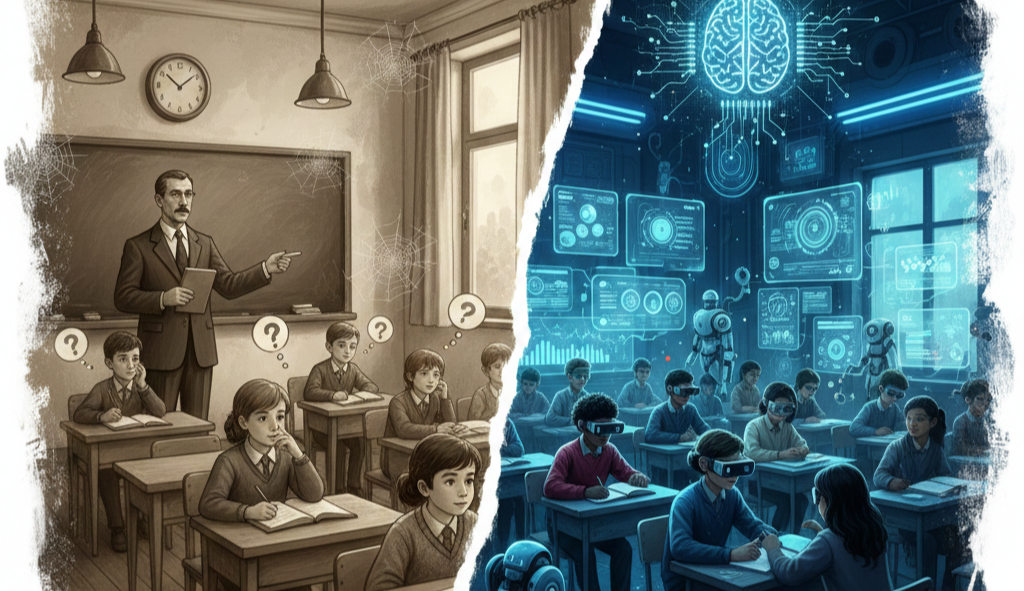
Just as digital classrooms replaced chalkboards, AI-powered classrooms are becoming the foundation of modern education.
For principals, school management teams, and teachers, the question is no longer “Should we adopt AI?”
It is “How quickly can we adopt AI in a way that truly benefits our students and teachers?”
Modern schools cannot afford to delay AI adoption, because the future of education is already unfolding inside today’s classrooms.